
Comments on a Live Blogged Revolution
|
Update 13:30 EST 1/31
As the protests continue unabated, the internet remains largely blocked with the exception of Noor ISP which serves roughly 8% of Egyptian traffic. Internet activists have galvanized into a group called WeRebuild which is working to bypass restrictions. Their most interesting strategy so far has been to coordinate with international ISPs to provide international numbers which Egyptians can call with dial-up modems. Also fascinating is the steps ordinary Egyptians are taking to protect themselves, the TOR anonymizing service has seen a quadrupling of users from those lucky enough to be connected through Noor. The most promising possibility is in further development of wireless mesh networking. The Serval Project and the implementation of Wi-Fi direct mean we could only be a few years from a time when activists can set up ad-hoc networking that would be invisible to government detection.
Update 20:24 EST 1/28
I think today’s events have demonstrated that Maria Popov was right to call Malcolm Gladwell #wrong for decrying the use of social media for social change. More information does make a difference. We’ve seen important germination of these revolutions being conducted online before the governments were able to close down information networks. Wired has a fascinating account of the IT department of Tunisia and how Ben Ali was only barely cognizant of the danger of social media in facilitating coverage and organization. While Egypt’s Hosni Mubarak at least turned off the network, he only did it after there was enough online social networking to spark more real life gatherings. Another difference is the rise of Al-Jazeera and other satellite networks which are able to show coverage from different areas of the country. However, I think the biggest driver of these revolutions is demography, the youth bulge from high birth rates and declining mortality is causing bloated corrupt societies to start to show signs of age.
—-
This post was originally going to be about Wikileaks, specifically the Swiss banker recently convicted for leaking the information of hundreds of ludicrously wealthy tax fraudsters. However the live-blogged revolution in Egypt makes for much more pressing discussion.
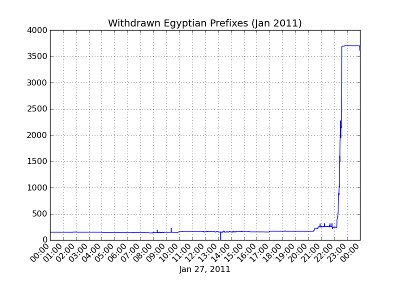
Network Intelligence Firm Renesys captured the moment Egypt unplugged from the Internet
First as to whether this is a Facebook Revolution, since apparently Tunisia was a Twitter one, which leaves me wondering if a revolution in Yemen wouldn’t be driven by Gowalla. The truth is the revolutions aren’t a result of social media anymore than the wave of revolutions twenty years ago were Samizdat Revolutions or 1776 was a pamphlet and newspaper revolution. While the government of Egypt may think blocking all Internet traffic is going to prevent people from communicating, they like the pundits who claim none of these things could happen without social media are overstating the importance of any one channel of information.
These revolutions are happening because citizens are tired of levels of corruption, repression and economic incompetence that would make autocrats of any century proud. This isn’t to downplay the significance of emerging technologies in supporting mass political movements. The number of cameras means that it is vastly more likely for the repressive actions of a regime to be documented. However the more important question of whether people will turn out in the streets is independent of how they become aware of the protests.
The underlying issue of course is that technology is having an ever more significant role in helping to strengthen communications and information sharing. What remains to be seen is whether this will eventually prove more beneficial to the dictators or the revolutionaries. But for once it’s possible to eavesdrop live on a revolution, which is an opportunity that shouldn’t be missed, it’s not every day that tyrants are overthrown. 
The recent four-week online certificate course on TC105: Mobile Phones for International Development was our largest and most diverse class...
For the first time, an international observation mission will utilize mobile devices and formhub for collecting real-time data from its...

In August, along with announcing our Tech for M&E Diploma program, we kicked off a M&E Professionals Series, where we...