Since TechChange was founded in 2010, our logo has always had a dynamic quality to it. This past summer, we began playing with the logo to make it come alive, both visually and audibly, to better reflect the TechChange brand as interactive and engaging. That started the creative process behind the current TechChange animated logo known internally as the “Tech Sprout”. What follows is a conversation between the animator, Alon Askarov, and the sound designer, Erik Tans, on this creative and technical process.


Where did you begin to think about this animation challenge?

[Alon] “The first time I saw the TechChange logo I was struck by how dynamic it felt. The nodes that connect into the circuit board, the seed that grows into the plant, the clear, and yet, invisible line that is drawn between the blue and yellow halves of the circle. All of these elements, and some more, are what formed the story that is behind the ‘Tech Sprout.’”


How did you approach sound design?

[Erik] “In this particular logo animation, there is the progression of the animation from simple to complex, from seed to sprout and water, to the wider-environment scene. Within all of this I saw a certain ebb and flow. With the sound I wanted to mimic that tension and release, that anticipation that I saw in the animation. After seeing this pattern, I decided to make my production a roughly two-part composition: the first section being the tension-building audio following the growth of the sprout, and the second part being the release of the static logo bringing on a short, memorable theme.”

Screenshot: Working on the “TechSprout” in After Effects – Audio and Animation Timing.

Was there anything different from how you had approached a similar process before?

[Alon] “Usually when I start animating, I break the static image down on the page into rough thumbnails and I look for composition, arcs, negative spaces, color, and shape. However with this animation I took a slightly different approach and Instead of laying down all the elements as a sketch, I just broke them apart and started timing them individually, like lego blocks. First the nodes, then the connections, then the plant with the leaves, and finally the blue and yellow circle.”

What was your next step in the process?

[Alon] “After I had the basic animation done I could see that the elements are telling a story, but it wasn’t complete. I sensed that there was something there but it wasn’t clear. At that stage of the production I went back to a basic step in the creative process which is: ‘share your work at early stage and get feedback’. Through other colleagues’ reactions, I could start figuring out what was working and what wasn’t.”

[Erik] “So much is communicated in sound: the rhythm and number of instruments; their sequence; organic or inorganic sounds; a fast tempo or a more slow and deliberate speed. What is communicated here should gel with what the brand is trying to communicate, and any audio can amplify the emotional response gained from the visual. With this in mind I began running through various instrument sounds and melodies, looking for something that would help tell the “story” of the animation. What really inspired me was the initial circle, and how it seemed to bounce into the frame like a violin starts up an orchestra: one violin for one circle. As the other circles entered the frame, the rest of the violins come in and crescendo like an inhaled-breath. I was aiming to mimic the rise in the graphic with this rise and tension in the music, and help to tell the “sprout story”.

“The flash which introduces the text logo is a turning point: with a swooping sound the graphic sprout is established, and the previous tension is released with the four-note melody coming in via a ‘tech-like’ synthesized sound. I wanted to leave the viewer with a short and memorable audio statement at the end to serve as an anchoring identity.”


How did the audio and visual elements work together?

[Alon] ”Now that I had the instruments tuned to the pitch, I could start building the beat. Finding the right timing was a lot of trial and error, timing each element to it’s natural pace and bringing them all together in harmony. I ended up producing 8 versions of the timing, each time pushing it a little bit further.”

[Erik] “From this point, we started a back-and-forth “improvisation” where we traded changes and influenced each other’s process. We took feedback from the rest of the production team as we changed the length, placement of hits, and- working within the limitations we set for ourselves- honed the feel of the story. In this way we balanced our artistic instincts with a craft-process which allowed us to change a static logo into a story with an emotional response.”

Get over 50% off tuition for Introduction to Intrapreneurship online course

Could the U.S. government shutdown be an opportunity for innovation? Being outside the confines of the office presents an opportunity for employees of any agency to develop the ideas and skills needed to advance innovation. In other words, here’s a chance for furloughed U.S. federal workers to focus on government innovation, and TechChange wants to help: starting today, TechChange is offering furloughed U.S. federal employees to take our Introduction to Intrapreneurship course for only $50.

More than ever, U.S. federal employees must find ways to maximize impact on a budget in one of the largest bureaucracies in the world. But where does innovation in a big bureaucracy come from? Ideas can come from every level of an organization, and are sometimes initiated by middle management or those in junior level-roles in a hierarchy. There’s a saying that, “Scarcity fuels innovation.” Outside the normal confines of the office, in a fresh setting, creates a breeding ground for new and innovative ideas. Thus the furlough is a great opportunity for government workers to discover and plan for new value-creating ideas.

Fortunately, government innovation has precedence. Todd Park, the Chief Technology Officer of the United States of America, is a great example of a government innovator. At the age of 24, he co-founded AthenaHealth, a company providing digital healthcare business services including electronic medical record services and virtual medical billing that went public on NASDAQ in 2007. In 2009, he accepted a job in the White House as the Chief Technology Officer of Health and Human Services (HHS) where he championed open innovation for government initiatives. He launched a series of hackathons and “datapaloozas” to make government data more available to public. In 2012, Park was promoted to CTO of the United States and special advisor to the president on technology. He has since launched the Presidential Innovation Fellows program.

TechChange wants to make it easier to empower U.S. federal employees to become intrapreneurs, applying entrepreneurial and start-up practices like Todd Park, to create innovation within their respective government agencies. Our Introduction to Intrapreneurship course, which was recently mentioned in Fast Company, is an opportunity for furloughed workers and other institutional innovators to learn from each other and be empowered to inspire change at their respective organizations, whether it be a federal government agency, an NGO, or a corporation.

What is Intrapreneurship?

A Beginner’s Introduction to Institutional Innovation

Written by Joe Agoada and Jennifer Estevez, Co-facilitators of TC108a: Intro to Intrapreneurship

Intrapreneurship defined

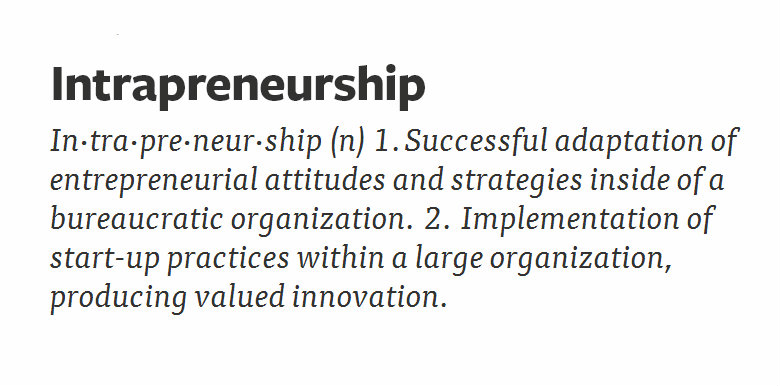
In·tra·pre·neur·ship (n) 1) Successful adaptation of entrepreneurial attitudes and strategies inside of a bureaucratic organization. 2) Implementation of start-up practices within a large organization, producing valued innovation.

Where does the term intrapreneurship come from?

The word “intrapreneurship” sounds like a new term, but it in fact has some history to it. The term was first discussed in a 1978 piece by Gifford and Elizabeth Pinchot titled “Intra-Corporate Entrepreneurship (Some Thoughts Stirred Up by Attending Robert Schwartz’s School for Entrepreneurs)”. Norman Macrae’s 1982 Economist article, “We’re all Intrapreneurial Now” further explores intrapreneurship and gives naming credit to the Pinchots. However, the word seems to have gone into relative hibernation until the dot.com bubble burst and Silicon Valley innovators started to look beyond the newest internet start-up for growth in the technology sector.

Intrapreneurship vs. entrepreneurship, per Guy Kawasaki

For a modern understanding of intrapreneurship, we can look at one of its most vocal proponents: author, motivational speaker, and venture capitalist Guy Kawasaki. Kawasaki was an early employee at Apple and a “chief evangelist” at the company for years.  With his 2004 book, Art of the Start, he began making direct references to intrapreneurs and has recently become a more vocal advocate. For example, he wrote this  July 2013 blog post on LinkedIn on “The Art of Intrapreneurship”. Here’s an excerpt:

  • “There are lots of guys and gals inside established companies who are as innovative and revolutionary as their bootstrapping, soy-sauce-and-rice-subsisting, external entrepreneur counterparts. This is for these brave souls who face a different kind of reality and must practice the art of entrepreneurship inside a company—or “intrapreneurship.'”
  • “From the outside looking in, entrepreneurs think intrapreneurs have it made: ample capital, infrastructure (desks, chairs, Internet access, assistants, lines of credit, etc), salespeople, support people, and an umbrella brand. Guess again. Intrapreneurs don’t have it better; they simply have it different. Indeed, the reality is that they probably have it worse because they are fighting against ingrained, inbred, and inept management.” – Guy Kawasaki

Bottom line: intrapreneurship is difficult, challenging, and nuanced.

Defining intrapreneurship: the starting point to inspiring institutional innovation

 Understanding exactly what intrapreneurship is can be a starting point in igniting growth and innovation within institutions. Harnessing the intrapreneurial approach can empower workers of any generation to advance their careers while improving their organizations. Intrapreneurship is especially helpful for junior-level employees and mid-level managers wanting to overcome the obstacles associated with getting consensus and support for innovative new ideas in the workplace. Getting employees to understand the concept of intrapreneurship is the first step to empowering a new cadre of innovators within institutions; nurturing intrapreneurship just may be the key to powering the global economy forward.


Learn more about intrapreneurship.

Join us with Ashoka Changemakers and other past, current, and aspiring intrapreneurs across the world that are sharing and learning the tools and techniques to innovate within their organizations for social change in TC108: Social Intrapreneurship – Innovation Within Institutions. The course begins February 24 – March 21, 2014. Enroll now to lock in your early bird discount and group rate!


About Joe Agoada

Joseph Agoada is the Resource Mobilization Coordinator for the UNICEF New York HQ Social and Civic Media Section in the Division of Communication. He has held this post since August of 2011 when he also founded and launched UNICEF-GIS. Prior he implemented UNICEF’s World Cup in My Village in Rwanda and Zambia. Between 2008 and 2009 he worked directly for Amy Smith, founder of the MIT D-Lab as a course administrator and then conference organization for the 2009 International Development Design Summit. In 2008 he was named an International Youth Foundation a Global YouthActionNet Fellow and in 2012, and a Google Personal Democracy Forum Fellow. He is a graduate of the University of Wisconsin-Madison and Johns Hopkins School of Advanced International Studies and currently resides in Washington, D.C.

According to the mHealth Alliance, in developing countries, the average doctor to patient ratio is 1 doctor for every 250,000 patients. Yet those same countries account for nearly 80% of the over 5 billion mobile subscriptions worldwide.

For people everywhere, access to a mobile phone can mean better access to health information, which leads to more informed choices and improved well-being. A great example of how mobile phones are making a difference in promoting health is with the Mobile Alliance for Maternal Action partnership that “has developed free, adaptable messages informed by experts in maternal, newborn and child health” that are being used and downloaded by 161 organizations in 54 nations around the world.

To learn more about how mobile phones are affecting developing nations in the realms of public health and beyond, check out our upcoming courses on Mobiles for International Development and mHealth. Also see our guest blog post from the mPulse blog on how we’re teaming up again with mHealth Alliance to mobilize mobile health with online learning.


We’re excited, honored, and humbled to be featured in Fast Company as one of the “best learning resources for aspiring social entrepreneurs”, with recognition for the “hybrid” online/offline learning category!

Here are some highlights from the article:

  • “Their open courses draw an international audience of participants, interested in social media and social change. They also create custom courses in partnership with organizations such as the United Nations, World Bank, USAID, UNICEF, Red Cross, US State Department, training student leaders in Pakistan, civil society leaders in Sudan, or international aid workers.”
  • “Nick Martin, one of the founders of Techchange, saw a growing need in his field for continuing professional education. “We took dozens of online courses from all kinds of providers and found that most of them were pretty awful. So we set out to build a model that was more social, interactive, scalable, and suited to the needs of the social change community.”

See the full article on Fast Company here.Fast company logo_blog post

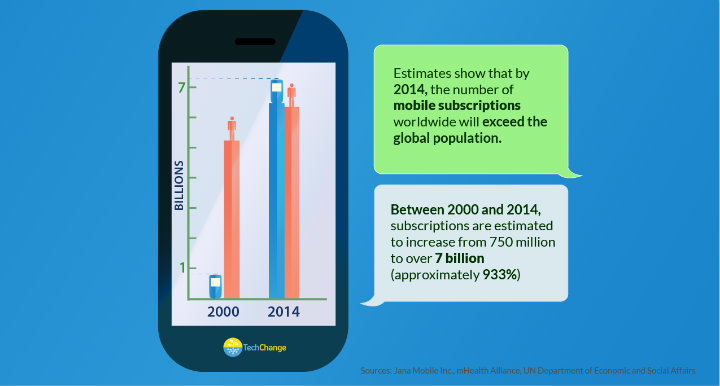
Infographic global mobile subscription vs. population 2014Estimates from the mHealth Alliance, the UN Department of Economic and Social Affairs, and Jana Mobile Inc. show that by 2014, the number of mobile subscriptions worldwide will exceed the global population. Between 2000 and 2014, subscriptions are estimated to increase from 750 million to over 7 billion (approximately a 933% increase).

What do these statistics mean for the world, especially in developing countries? What implications does mobile subscription expansion have for public health, banking, education, and agriculture? Why do mobiles matter for international development? What emerging mobile technology is having the greatest impact?

Learn more about the global impact of mobile technology with our TC105: Mobiles for International Development course, which runs September 8 – October 3, 2014.


We’re just one week away from the start of our Mobiles in International Development course and we couldn’t be more excited!

This is the 8th time we’ve run TC105 and it’s going to be better than ever with our latest updates. We have new animated videos, a revamped course platform, and fresh content to get you caught up on the latest mobile technology for the developing world with better networking, content viewing, and engagement. Check out this video to get an overview of the course, and learn why mobile phones matter for international development.

So far, we have participants enrolled from over 12 countries including Austria, Cote D’Ivoire, Ecuador, Malawi, The Netherlands, Norway, Trinidad & Tobago, Tajikistan, Tanzania, Thailand, USA, South Africa, and more joining every day. These participants represent several organizations such as the World Bank, UNDP, International Youth Foundation (IYF), NORC at the University of Chicago, Mission Measurement, Johns Hopkins School of Advanced International Studies (SAIS), Digital Afrique Telecom, Ayala Consulting, Millennium Water Alliance, Umtapo Centre, Radio Zamaneh, Kenan Institute Asia, Tribeca Film Institute, JEVS Human Services, and others.

We’re especially looking forward to our special line-up of guest speakers including:

It’s not too late to join this global online learning community. Register for Mobiles for International Development now by clicking here.

We’re excited that TechChange’s founder and president, Nick Martin, has been selected as one of the 2013 PopTech Social Innovation Fellows. The PopTech Social Innovation Fellowship program supports up-and-coming social entrepreneurs in scaling their solutions to some of the world’s toughest problems including human rights and healthcare.

Nick will be joining 10 other Social Innovation Fellows along with the Science Fellows this October at the ”Sparks of Brilliance” PopTech 2013 event in Camden, Maine. During this event, Nick will be receiving intensive training and mentorship from experts and peers that will ultimately help him make a greater impact in the online learning social enterprise arena.

Congratulations, Nick! You can follow him on Twitter @ncmart.


Written by Jennifer Estevez.

Check out our entry here: http://kng.ht/1erYBej

Have you heard of the #NewsChallenge? It’s a funding source for innovative ideas managed by the John S. and James L. Knight Foundation. Since 2007 the Knight Foundation has run various challenges and given away over $75 million to over 400 winners. In August the Knight Foundation launched its latest #NewsChallenge on the theme of Health asking, how can we harness data and information for the health of communities.

When the health theme was announced we immediately realized it would be the perfect time to present a new and fun idea we had been kicking around the TechChange offices for a while, a Massively Open Online Conference (MOOCon). Massively Open Online Courses (MOOCs), which enroll thousands for a single class, are rapidly growing in popularity. Coursera, Edx and Udacity offer MOOCs from big names in education including Harvard, MIT  and most recently the Wharton School of Business. Even Google is getting in the game with MOOC.org. However, as this Time article points out, MOOCs face a major problem; very low completion rates. While thousands sign-up, only a small fraction go onto finish, and even then it can be difficult to measure the learning impact of those who enroll.

That’s what got us thinking. If a MOOC has great engagement from the start, but limps to a finish, why not just limit the experience to those exciting first few days? In this way, a conference adaptation would have a lot of potential. The concept of the MOOCon is still in its infancy. Hewlett Packard is the founding partner of one of the first ever instances, the Global STEMx Education Conference, and it starts today (September 19th). The MOOCon idea is incredibly inclusionary because it can offer a quality learning opportunity without the high costs of travel or admission.

TechChange’s mHealth course is incredibly popular, so it became the natural topic for our MOOCon idea. The online conference would run for three days, non-stop, and be open to participation by anyone, anywhere with a connection to the world wide web. Those that join our MOOCon would participate from their computers at work or home in a highly interactive environment.  Participants would have the opportunity to hear from mHealth experts, network with other participants in forums and chat rooms, and engage in public health data simulations. We think this proposal gets to the heart of the challenge,  creating a public-facing innovation that educates and ignites conversation about how mobile phones can harness data and information for the health of our communities.

What do you think of the concept? Have any ideas for the MOOCon or want to put in your opinion? For the next three days all the #Newschallenge entries are open for feedback. Checkout out our Entry and over 600 others at: https://www.newschallenge.org/challenge/healthdata/feedback/massively-open-online-conference-on-mhealth

TechChange takes fun seriouslyWe’re excited to join the Tech Cocktail DC Startup Showcase tomorrow evening at the headquarters of 1776. If you’re attending this Tech Cocktail DC event, you’ll hear from TechChange Founder & CEO, Nick Martin, who has just returned from his travels in Amsterdam and Nairobi.

Nick will speak briefly on what makes TechChange unique among other startups and social enterprises in the DC area. You’ll also be able to check out some of TechChange’s latest online professional courses that are training leading organizations in international development including the World Bank, the U.S. Department of State, and USAID.

Hope to see you there! If you can’t make it, we’ll be live-tweeting the event @TechChange.

Also, don’t forget to vote TechChange for DC’s Hottest Showcasing Startup in the Tech Cocktail DC poll here.