
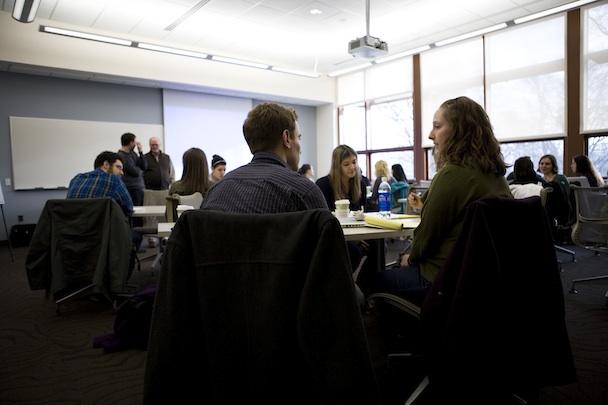
This past weekend Dr. Michael Gibbons and I taught a 20-hour graduate skills institute at American University’s School of International Service entitled Applications of Technology for Peacebuilding. Students came from a variety of AU programs, including the International Peace and Conflict Program (IPCR) in the School of International Service, the AU Business School, and the AU Law School.
We at TechChange were especially excited about this course, as it allowed us an opportunity to incorporate a variety of new tech-based tools in the curriculum, both those created by TechChange and others. The inclusion of these tools was designed to foster collaboration, allow for course materials to be accessed in innovative, non-linear ways, and to give students an opportunity to participate in hands-on simulations using some of the same tools (e.g. Ushahidi) currently being used by practitioners in the field.
Hybrid Learning Model: Prior to the course, we created an online community with a number of dynamic features. These included an interactive self-guided pre-course assessment that provided a general overview and personalized reading recommendations, an interactive case study library, visual maps for readings and other multimedia, an interactive class corkboard for posting course announcements and expectations, bookmarking tools for capturing links that emerged during classroom discussion, and more. See a sample unit of a TechChange course with a number of these features here. We felt this was an effective way (much more so than Blackboard) to not only display and organize the content of the course, but also to capture key learnings as they evolved. We’re excited to continue to experiment with this and other blended learning and hybrid learning models.
Ushahidi Crisis Mapping Simulation: On Saturday morning, students took part in a two-hour crisis mapping simulation, using the Ushahidi platform to map and monitor hypothetical election violence in Afghanistan. This was a more in-depth version of a simulation we ran at UPEACE last summer, as described on the Ushahidi Blog. This time, we set up 5 teams (the UN Staff, Election Monitors, Polling Stations, Citizens, and the Taliban) and organized the simulation into 6 ten-minute round. In each round, every citizen had to choose a polling station to vote at based on the information flow that trickled down to them from the election monitors visiting polling stations and texting back to UN staff who plotted information on the Ushahidi map. The Taliban team was charged with the task of sending falsified crowdsourced data to obscure the process. We also introduced a number of variations for each round: staggering voting of citizens and allowing them to communicate with each other, reducing the number of the election monitors, etc.
Prezi and Case Study Exercise: In order to introduce the students to some of the organizations and tools working to address different elements of the peacebuilding/ development spectrum, we created a case study library in an online tool called Prezi. We then divided the class into 6 groups (Health, Education, Banking/Livelihoods/Finance, Advocacy & Citizen Journalism, Governance, and Crisis Response) and had each group explore the profiles of three tools listed under each category, reflect on their utilities for peacebuilding, and attempt to discover other relevant tools not listed in the library. Check out the TechChange Case Study Library here. Prezi was a great way to organize and curate this activity and we will feature more about this tool and other insights into zooming presentations in a subsequent blog post.
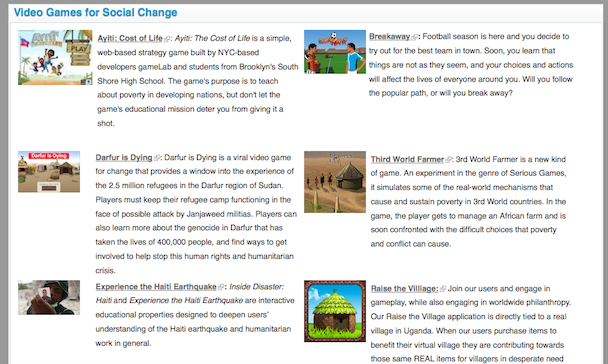
Video Games for Social Change Activity: On Sunday morning we facilitated a 90-minute unit on video games for social change. We started with Jane Mcgongical’s TED Talk “Can Gaming Make a Better World” and then divided into groups to look at the following games: Ayiti: the Cost of Life, Experience the Haiti Earthquake, Breakaway, Participatory Chinatown, Third World Farmer, Stop Disasters, Raise the Village, and Darfur is Dying. Some themes and questions that we explored incude: The responsibility of empathy – can we as gamers responsibly and respectfully inhabit another person’s experience? If so, how can this be done without potentially trivializing others’ hardship? How can NGOs and designers better incorporate local contextual input into game design? How do NGOs and designers balance their social objective with the typical expectations related to gameplay? Are games more effective than documentaries for precipitating behavior change? Visit the TechChange Unit on Games for Change in our online course and try playing the games.
Final Projects: For a final project we divided the class into teams and presented the following assignment:
In October 2011 (7 months from now), Liberia will hold its second democratic election. This signifies a critical juncture in post-war recovery efforts for Liberia, as the United Nations peacekeeping force is hoping to hand over security responsibilities to the relevant government authorities. You are part of team that has been recently hired by CARE International. You have been tasked to make recommendations about which technologies and software should be used help improve communications, monitor violence levels, and provide public service delivery during the time leading up to the elections and on the day itself. Consider the tools we have discussed in class, and take some time to research other relevant tools in the Case Study Library…
It was impressive to see such a range of creative strategies and considerations taken into account by each group. To download the full assignment click here.
Parting Thoughts: All in all, it was a great experience and we’re excited about teaching future graduate courses at American University, George Washington University, George Mason ICAR, and any others that are interested. We’ll also be doing a three-day short course this summer (July 4-6) on New Technologies for Educational Practice at the United Nations mandated University for Peace in Costa Rica. Come join us.
As with any class, we recognize that there is always room to improve upon our approach and activities. We’re really interested in hearing from you and from others who are working to develop new models for hybrid learning, education 2.0, next generation eLearning tools, and more. Feel free to reach out to us with ideas and feedback at TechChange or write to me at nick [at] TechChange.org