Path one
Sustain & Scale
Diversify revenue, productize services, build partnership ecosystems, and grow impact on your own terms. Taught in depth in both phases.

A free business model accelerator for social impact leaders, built to reach hundreds and go deep with the few ready to act. It drew three times the applications it planned for.
The 2025 funding contraction did not create the business model problem in the social impact sector. It made it impossible to defer. InterAction’s 2023 survey of INGO chief executives found that half were already working on implementing a new business model for their organization, and that was two years before the cuts landed.
Knowing you need to move beyond grant dependency is not the same as knowing how. Strategy consulting exists, but it is priced out of reach for exactly the organizations most exposed. There is no shortage of business model content online either, and almost none of it accounts for what it is actually like to run a mission-driven organization with a board, a funder base, and programs people depend on.
The Endless Foundation wanted to close that gap: a serious program, offered free, good enough that chief executives would give it real calendar time. They brought in Whitten & Roy Partnership for the business model and sales content, and TechChange to design, build, deliver, and measure the program end to end.
The recruitment goal was 100 participants.
Two constraints shaped every design decision. The audience was overwhelmingly senior, meaning people whose calendars do not accommodate a course. And the program had to do two different jobs at once: introduce concepts broadly to anyone who wanted them, then go deep with the smaller group genuinely ready to change something.
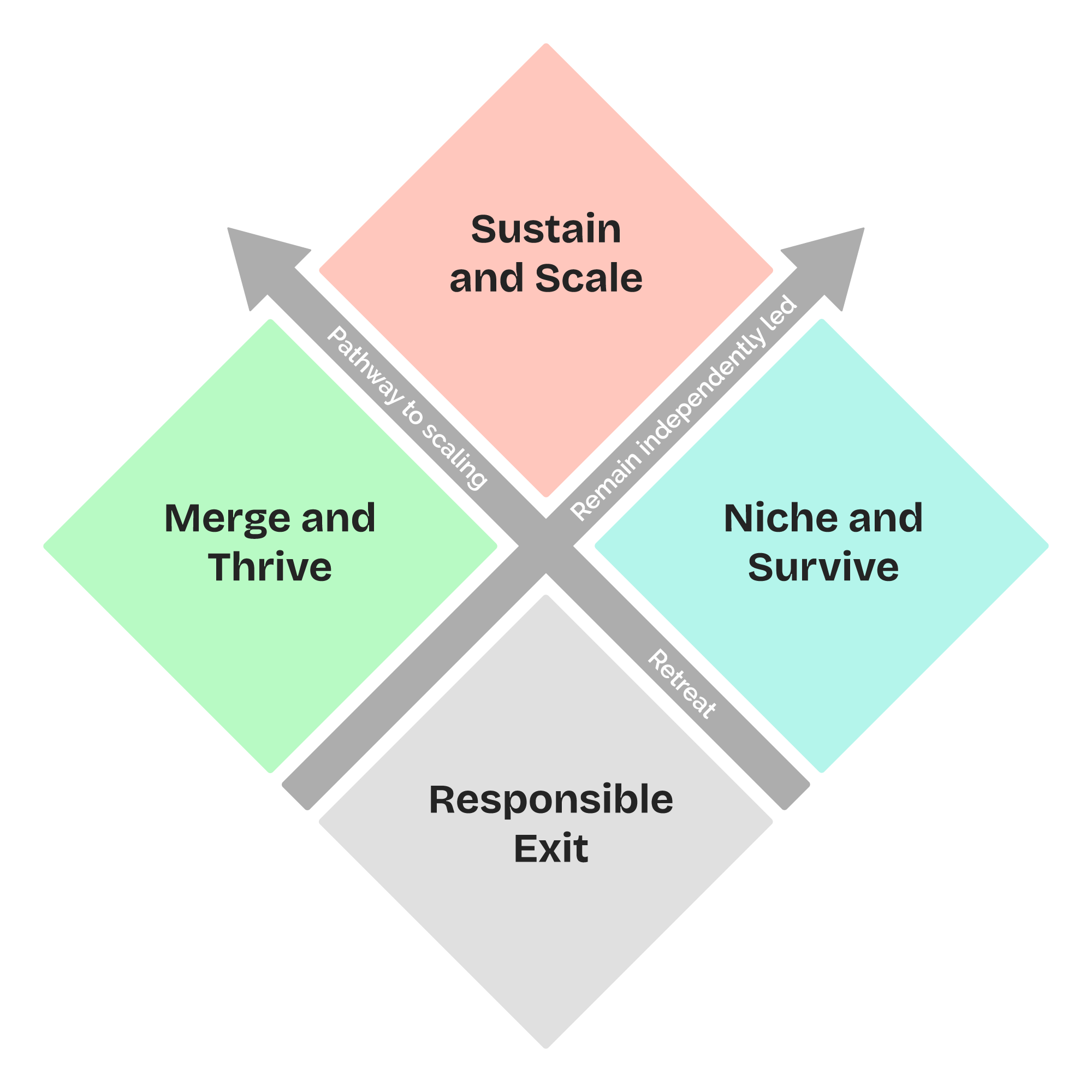
Rather than choose between reach and depth, we built for both and let the first phase qualify the second. A six-week Inclusive Phase, open globally, introduced core concepts through weekly live sessions and self-paced modules. It ended not with a certificate but with a decision: sustain and scale, or merge and thrive. Leaders who chose to pivot and grow independently applied into a Selective Phase, where the work got specific.
By the time the Selective Phase opened, everyone in the room had chosen to be there. That is a very different starting point than a roster of people who were assigned a training.
We encouraged multiple leaders from the same organization to apply together, and the Selective Phase reflected it: 32 participants from just 12 organizations, close to three per organization. Business model change is not an individual skill. Sending one person to learn it and come back to convince everyone else is the most common way this work dies. Sending two or three means the conversation continues between sessions. For example, AIH Impact Collective and Career Pivot both sent three senior leaders to participate, and the Artist’s Helpdesk sent both of their full-time staff. All three organizations report still using the frameworks they learned.
Every Inclusive Phase session paired a framework with leaders who had actually run the play. Kevin Starr of Mulago and Neha Verma of Intelehealth on funding trends and resilient models. Nithya Ramanathan of Nexleaf Analytics and Alexandra Grigore of Simprints on revenue diversification and productized services. Robin McKinney of the CASH Campaign of Maryland, Blair Glencorse of Accountability Lab, and Chris Proulx of Humentum on mergers and co-leadership. Sean Burke of Accenture Development Partnerships on refining business models. Nearly all were operating organizations at chief executive level, and they brought the parts that do not make it into case studies.
We built a points system, PivotPoints, that logged every meaningful interaction: opening a module, playing a session, posting in a thread. Certificates were tied to it rather than to attendance. That gave the program a live signal of who was actually engaged and where the drop-offs were, week by week, instead of a headcount that tells you nothing.
Registration tells you who signed up. Engagement tells you who is actually rethinking their business model.
The Pivot Model, developed by Whitten & Roy Partnership, sat at the center of the program. Naming merger and exit as legitimate strategies rather than failures is what made the reflection real.
Diversify revenue, productize services, build partnership ecosystems, and grow impact on your own terms. Taught in depth in both phases.
Strategic partnership, collaboration frameworks, and co-leadership. Explored with leaders who had been through a merger and come out stronger.
Narrow deliberately. Hold a defensible position at a smaller scale rather than stretching a thinning budget across everything.
Wind down with dignity, protecting staff, partners, and the communities served. On the table from week two, which is why the other three could be chosen honestly.
Six weekly live sessions with self-paced modules between them, open to social impact leaders anywhere in the world. Concepts, examples, and a closing decision point.
Six biweekly 90-minute working sessions, deliberately spaced so teams could take the work back to colleagues in between. Revenue design, pricing and cost recovery, go-to-market, and live selling practice.
End to end, participants were engaged with the program for more than 18 weeks.
Three findings stood out.
The program helped me set aside external noise, particularly uncertainty and urgency, to intentionally map out our next stage of growth. It created space for us to think strategically about what it truly means to scale while remaining lean.
Rita Sembajwe, RENS Digital · Inclusive Phase participant
It came at the right time, because of all the changes that are happening and because our organization is rethinking and re-strategizing. It helped us think through how to navigate and how to approach what comes next.
Matiko Machagge, inSupply Health Tanzania · Selective Phase participant
The interesting question about a program like this is not whether people enjoyed it. It is whether their revenue mix actually changed. We captured baselines at intake and are now collecting follow-up data through surveys and focus groups on change in total annual revenue, change in the share coming from grants, from donations, and from earned revenue, and documented examples of applied learning.
So the honest state of the evidence is this: a clear demand signal and unusually strong engagement now, with business model outcomes still being measured. We would rather say that than publish a number we cannot yet stand behind.
The recommendation coming out of this delivery is more cohorts, not a longer one. In the future, we’d love to do additional runs of the Inclusive Phase for African and Asian time zones, and a health-sector cohort where the examples and the peer group can be far more specific. Multiple cohorts would also build a deeper bench of candidates for each Selective Phase.
Participants have asked to keep access to the platform and to each other, which points to the other obvious extension: turning the discussion threads into a standing community of practice rather than a course that closes.
TechChange has designed and delivered learning experiences and convenings since 2010, reaching more than 1 million learners across 198 countries and running over 1,000 courses and events. We work with governments, multilaterals, NGOs, foundations, universities, and corporate partners to turn complex goals into experiences people actually want to be part of. From a single workshop to a global forum, we bring the same thing to every room: instructional design, production, facilitation, and technology in one end-to-end team.