
The pivot is underway, and it looks different for everyone.
In January 2026, we launched Pivot for Impact with support from the Endless Foundation and our content partner, Whitten & Roy Partnership (WRP). The funding landscape for mission-driven organizations had shifted, and professionals working in this space were exploring career pivots.
Endless wanted to support social impact leaders to move beyond grant dependency by building products that meet real market needs, developing sales and business development strategies, and diversifying revenue through partnerships with governments, businesses, and consumers. They also wanted to know whether that learning would hold up once Pivot for Impact ended.
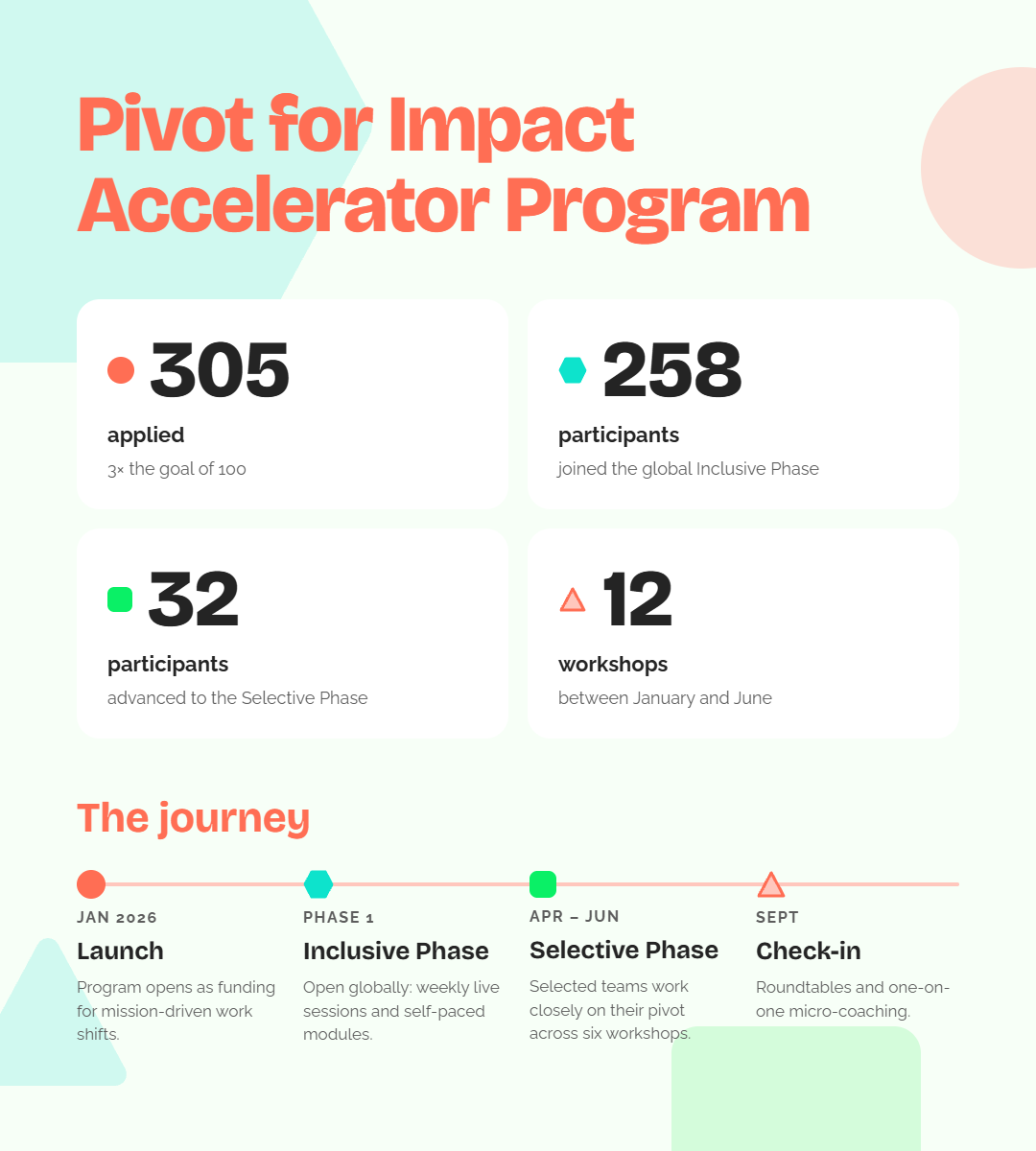
We split the program into two parts: the Inclusive Phase, open globally, which introduced core concepts through weekly live sessions and self-paced modules; and the Selective Phase, which invited selected applicants from the Inclusive Phase to work more closely on their journey to pivot and grow their organizations. 305 people applied, three times our goal of 100, and 258 took part. From there, 32 participants from 12 organizations joined the Selective Phase, working through six workshops between April and June.
This September, we invited Selective Phase participants back together for roundtables and one-on-one micro-coaching led by business coach Nick Kingesley-Johnson of WRP. We wanted to understand the program's broader impact and how leaders were pivoting their organizations. In addition to surveys tracking revenue growth down the line, we wanted to see examples of applied learning.
Most teams have bought in. Time is the harder problem.
Nick opened each session with a quick pulse check: On a scale of 1 to 5, how far has your team or board come in embracing earned income? Most people landed around a 3 or 4. Kgauhelo Dube of The Artist’s Helpdesk went right off the scale with an 8 out of 5.
Amanda Oenbring, who leads the Upcycled Food Association, gave a 4 and was quick to say the program wasn't the issue. Amanda runs the association with one part-time colleague. The will is there. The hours often aren't.
The biggest early win was learning to say “no.”
We expected people to lead with new products. Instead, almost everyone talked about focus. The business model canvas came up again and again as a filter for which opportunities to chase.
Fathima Beckmann, founder of Madrid-based AIH (An Inspired Her), ran two workshops with their own advisory team to bring the frameworks into daily work. The Artist’s Helpdesk, which connects South African artists to paid work, told a similar story. It has defined a clear core offer and stopped trying to be everything to everyone.
Kgauhelo was honest that saying publicly what you won't do can shrink your funding pool at first. The bet is that it draws the right partners in over time, and Nick agreed.
Focus is already turning into things people can use.
Take the Upcycled Food Association. After narrowing to three priority segments, the team is prototyping a discoverability tool to help retailers and shoppers find members' upcycled food products. It goes to the board in November, with a launch hoped for by year-end.
inSupply Health, which strengthens health supply chains across East Africa, split its business development into three tracks: business-to-business, business-to-donor, and business-to-government. Those tracks now shape its FY27 work plan. This reflects one of Endless’ goals from the start–for organizations to create partnerships with governments and other businesses.
At a data-focused nonprofit in Europe, a program lead and a colleague turned the workshop lessons into a deck for senior leadership. Their first product, co-created with two nonprofits, starts market testing October 1.
A global social enterprise focused on advancing women’s economic empowerment via investment and finance, now has a clearer approach for top-of-funnel engagement.
Women First International Fund will ask applicants to its next grantee cohort, opening early next year, to bring an enterprise idea. This further dissemination of entrepreneurial thinking means the learning goes beyond the organizations which initially participated.
Getting your own organization on board is still the hardest part.
Boards can be cautious about changing who an organization serves, and leadership transitions can leave innovators unsure what to test.
One participant suggested speaking the board's own language and showing a pivot as an addition to the theory of change, not a departure from it. Another participant has instituted a Slack channel as a space to share frequent, lightweight updates on market signals, complemented by standing agenda items in team meetings to discuss insights. Nick added two tactics: find a board-level sponsor who will champion the work through any transition, and talk one-on-one with skeptical board members before the full board meets. As he put it, most boardroom decisions are really made outside the room.
Pricing gets easier once people can see the value.
For organizations used to donor funding, putting a price on their work still feels strange. Rose Nzyoka of inSupply Health raised exactly this as inSupply is in the process of determining prices for services and products for mid-sized private health facilities and pharmacies/chemists. Nick's advice: charge commercial clients commercial rates, offer nonprofits a tiered price, and test prices by actually selling.
Under all of it is value. When people can see what they'll get, price gets easier to talk about. That's why the Upcycled Food Association left the session planning case studies for each member segment.
The peer connections might be the best part.
Some of the best advice didn't come from Nick or from us. Rose pointed Fathima toward potential grassroots partners in Kenya. Joe O'Connor of Career Pivot, drawing on earlier work at a stand-up comedy nonprofit, encouraged The Artist’s Helpdesk to focus on one group of artists for a quarter before widening out.
Nick also shared an expression borrowed from the US Navy SEALs: slow is smooth, and smooth is fast. Rushing creates friction and mistakes, and work done poorly the first time has to be redone. As Nick explained, the point isn't to slow everything down. It's to be more discerning about what you take on, and to move at a pace your team can sustain.
The work continues, and that's okay.
Three months out, these leaders are still fine-tuning their pivots, including exploring new markets and new models. Change is iterative and takes work over time. What we saw was a group of leaders who have made real progress, know where they're headed, and have peers to call when it gets hard. That's the kind of lasting change Endless set out to support.
For the full story of how Pivot for Impact came together, read the case study.